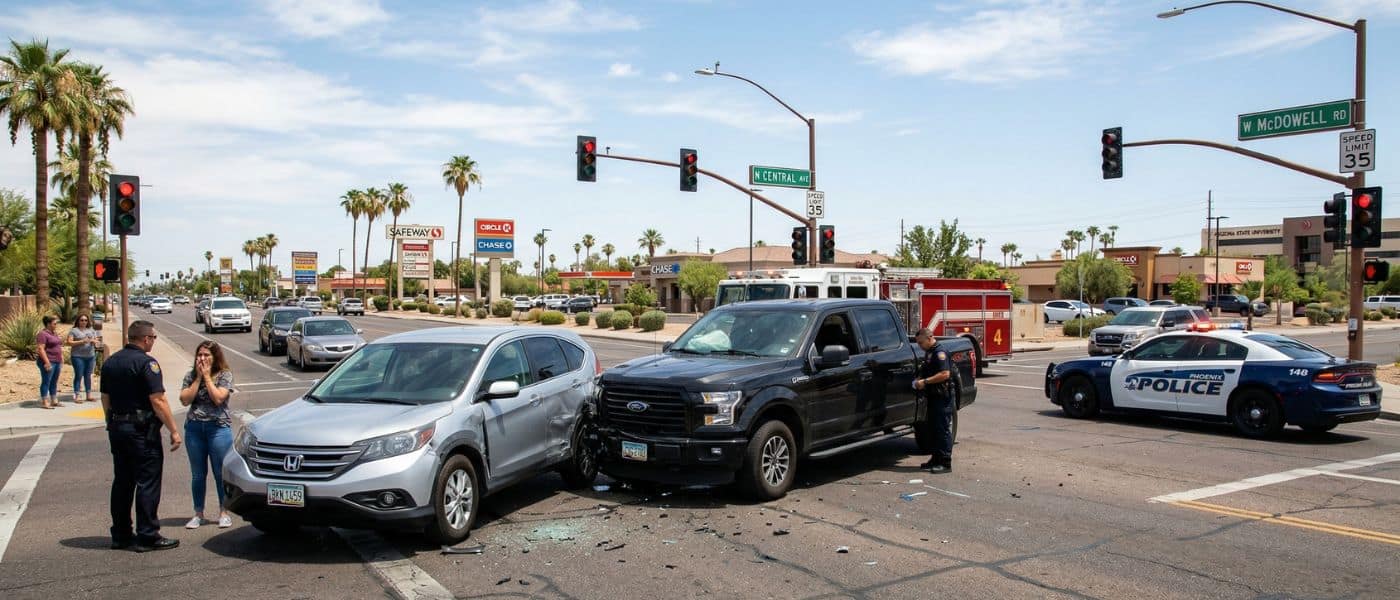
Phoenix Intersection Accidents: Determining Fault and Liability Guide
Intersection accidents in Phoenix are, unfortunately, pretty common. When they happen, figuring out who’s actually to blame is the key to getting compensation for injuries and property damage. In Arizona, whoever caused the accident is on the hook for the harm they caused, so proving fault is what decides if a victim can recover things like medical bills, lost wages, and other losses. Some of the state’s most dangerous intersections are in Phoenix, and crashes there often involve more than two cars, messy right-of-way arguments, and the usual finger-pointing over who ran the light or didn’t yield.
Fault in these wrecks comes down to evidence—think traffic cameras, police reports, what witnesses say, and Arizona’s traffic laws. The state uses a comparative negligence system, so even if you’re partly at fault, you can still get compensated (though you’ll get less). Typical causes of intersection crashes? Running red lights, bad left turns, distracted driving, and speeding. Each plays a part in figuring out who’s at fault.
Knowing how liability works, what evidence actually matters, and when to call a lawyer can be the difference between walking away empty-handed and getting what you deserve. This guide breaks down the process of proving fault, covers Arizona’s laws, and offers tips for protecting your rights after an intersection crash in Phoenix.
Understanding Liability and Fault in Phoenix Intersection Accidents
Intersection crashes in Phoenix are subject to specific fault rules based on traffic laws and negligence principles. The kind of crash, what the drivers did, and the layout of the intersection all factor into who’s legally responsible.
Types of Intersection Collisions
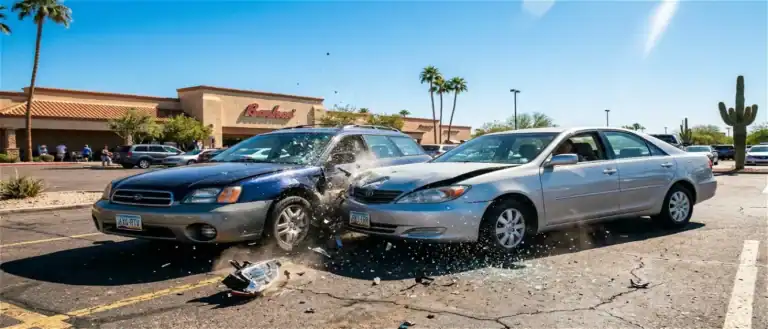
T-bone crashes happen when one car slams into another at a right angle—usually because someone ran a red or ignored a stop sign. Most of the time, the driver who struck the other car is at fault, unless the other person broke a traffic law.
Rear-end collisions at intersections are pretty straightforward. If you rear-end someone who’s stopped at a light, Arizona law usually says you’re at fault for not paying attention or following too closely.
Left-turn accidents? Those are common too. Arizona law says drivers making a left have to yield to oncoming traffic. So, the person turning left is usually responsible—unless the other driver was speeding or blew through a red.
Sideswipes happen when cars traveling side by side collide during lane changes or merging near intersections. Fault depends on who didn’t check their blind spot or failed to use a signal.
The Role of Negligence in Crash Responsibility
Negligence is the legal backbone for deciding fault in Phoenix intersection crashes. Drivers are expected to act with care, and when they don’t—by being careless or reckless—they can be held responsible if someone gets hurt.
Arizona uses a pure comparative negligence system (see Arizona Revised Statutes § 12-2505). Each driver gets assigned a percentage of fault, anywhere from 0% to 100%. Even if you’re partly to blame, you can still collect damages, but your share goes down by your percentage of fault.
Running red lights, not yielding, distracted driving, and speeding are all classic examples of negligence. If police hand out a ticket at the scene, that’s a pretty strong sign of fault, though it’s not set in stone—sometimes evidence tells a different story.
Sometimes, more than one person is responsible for a crash. Insurance companies and courts look at police reports, what witnesses say, traffic cam footage, and physical evidence to figure out how to split up the blame.
Common Causes at Urban Intersections
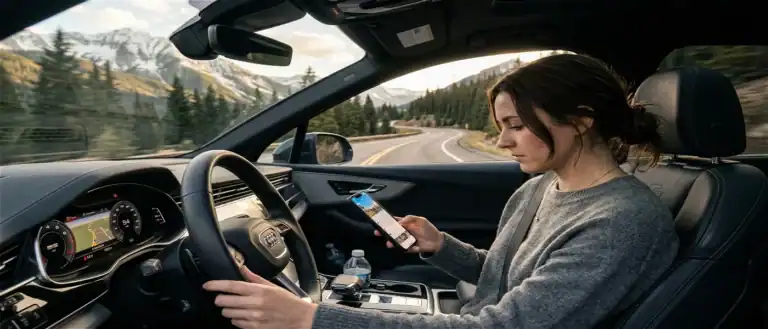
Distracted driving is probably the biggest reason for intersection accidents in Phoenix. People fiddling with their phones, messing with the radio, or just zoning out miss traffic lights and other cars. Arizona’s hands-free law bans holding your phone while driving, but, well, people still do it.
Running red lights is a close second. Some drivers misjudge the timing, others just gamble on the yellow, and some are simply not paying attention.
Bad left turns are another big one. Drivers misjudge how fast oncoming traffic is moving or don’t see other cars at all—sometimes because of sun glare or just not knowing the intersection well.
Speeding makes everything worse. Less time to react, longer stopping distances—it’s a recipe for disaster when lights change or someone else enters the intersection.
Arizona’s Comparative Negligence Laws and Their Impact
Arizona’s pure comparative negligence system lets injured people recover damages even if they’re partly to blame for the accident. This approach is a lot more forgiving than what you’ll find in some other states and has a direct impact on how much accident victims can actually get.
Pure Comparative Negligence Explained
Under Arizona law, you can recover damages no matter how much you’re at fault—even if it’s 99%. You’d only get 1% of your total damages, but hey, that’s something.
The amount you get is knocked down by your share of the blame. So if you win $100,000 but the jury says you’re 30% at fault, you walk away with $70,000. Insurance adjusters and juries use all the evidence—traffic cams, witness stories, police reports—to divvy up the percentages.
This system shapes both settlement talks and court decisions. Insurance companies love to argue that you’re more at fault than you really are, just to pay less. That’s why solid documentation—photos, tickets, witness accounts—matters so much.
Comparative Fault Versus Other Legal Doctrines
Pure comparative negligence is a lot different from contributory negligence, which a handful of states still use. Under that system, if you’re even 1% at fault, you get nothing. Arizona’s approach is way more generous.
There’s also modified comparative negligence in some states, which cuts you off from recovering anything if you’re 50% or 51% at fault. Arizona doesn’t do that—here, you’re still entitled to your share, no matter how high your percentage is.
When it comes to intersection crashes, liability gets divvied up depending on what each driver did. Ran a red light? Didn’t yield? Sped through the intersection? Each of those actions chips into the overall fault calculation. The point is, you pay according to your share of the blame.
How Fault Is Determined After a Phoenix Intersection Accident
Deciding who’s at fault after a Phoenix intersection crash is all about what cops write down, what cameras catch, and what the physical evidence shows. Each piece helps put together the puzzle of who messed up.
Police Reports and Official Documentation
Police reports are usually the starting point. Officers jot down what they see—car positions, skid marks, debris, weather, you name it. They’ll also get statements from everyone involved, plus any witnesses hanging around.
If someone gets a ticket for running a red or not yielding, that’s a big deal for fault. The report often comes with diagrams showing how the cars moved and where they hit each other.
Cops note stuff like skid marks (which show braking and speed), weather conditions, and any traffic light glitches. Insurance companies and courts lean heavily on these reports when assigning blame.
Physical and Electronic Evidence in Investigations
Physical evidence at the scene—skid marks, debris, dents—shows what happened and how. Skid marks can tell you who slammed on the brakes and from where. The way debris is scattered can show who hit who and at what angle.
Traffic cams are a game-changer in Phoenix. They catch everything: light timing, car positions, what drivers were doing. Dashcams—if someone has one—are also gold for proving what actually happened.
Phone records can show if a driver was texting or calling during the crash. Some cars have event data recorders that log speed, braking, and steering right before impact. Accident reconstruction experts sometimes get called in to piece it all together when the story isn’t clear.
Key Contributors to Intersection Crashes in Phoenix
Most intersection crashes in Phoenix come down to bad driver behavior—distractions, impairment, and a city layout that encourages high speeds and heavy traffic.
Distracted and Impaired Driving Behaviors
Distracted driving is everywhere. Drivers looking at their phones, fiddling with GPS, or just searching for a coffee shop miss lights and don’t see other cars.
Phone records are often crucial evidence. Lawyers can subpoena them to show someone was texting or using an app at the time of the crash. That can be the deciding factor when drivers argue about who had the green light.
Impaired driving is another huge risk. Alcohol, drugs (even prescription meds), and fatigue all slow reaction times and cloud judgment. Drunk or drowsy drivers often misjudge distances or blow through signals.
Common impairment factors include:
- Alcohol use
- Prescription meds
- Illegal drugs
- Driver fatigue, especially during rush hour
Speeding, Red-Light Running, and Traffic Signal Violations
Phoenix’s main roads have high speed limits—45 to 50 mph—so when someone’s speeding, intersection crashes can be deadly. If a car’s going too fast, there’s no way to stop in time when a light changes or another car enters the intersection.
Red-light running is a recipe for disaster. Drivers who gun it through yellows or just flat-out run reds cause brutal T-bone crashes. Luckily, a lot of intersections have cameras now, so there’s often video proof.
When you mix speeding with running red lights, the results are usually catastrophic—severe injuries, sometimes worse. In those cases, it’s pretty clear who’s at fault.
Establishing Negligence: Proving Duty, Breach, and Causation
To win a negligence claim after a Phoenix intersection crash, you have to show that the other driver had a duty to drive safely, broke that duty, and that this directly led to your injuries.
Duty of Care at Intersections
Every driver in Phoenix owes a duty of care to everyone else—other drivers, pedestrians, cyclists. This means obeying lights and signs, yielding when you’re supposed to, driving at safe speeds, and paying attention.
The details depend on the situation. If you’re going through on a green, you still have to watch for people in the crosswalk. If you’re turning left, you have to yield to oncoming cars. At a four-way stop, you have to know the right-of-way rules.
Usually, proving this duty isn’t hard—Arizona’s traffic laws lay it all out. If someone runs a red or doesn’t yield, they’ve probably breached their duty.
Linking Actions to Damages
Causation is about connecting the dots between someone’s mistake and your injuries. You have to show that the crash wouldn’t have happened without their negligence, and that your injuries were a foreseeable result.
Medical professionals are key in documenting injuries and proving they came from the crash. Accident reconstruction experts can help by analyzing the scene and showing how the other driver’s actions caused the collision.
To get compensation, you need real, documented harm:
- Medical bills (and future care)
- Lost wages or reduced ability to earn
- Car repairs or replacement
- Pain and suffering
If you can’t show actual damages, even a clear breach of duty isn’t enough to win your case.
Evidence Collection and Use in Fault Disputes
Proving fault in Phoenix intersection crashes takes the right kind of evidence—what happened, who did what, and who’s responsible. Witnesses and tech both play a big part.
Witness Testimony and Statement Analysis
Witnesses can make or break a case. People who saw the crash from the sidewalk, another car, or a nearby business can offer details about driver behavior, signal status, and vehicle positions.
Police gather witness info at the scene, and it goes into the accident report. Lawyers often follow up for more details that might not have made it into the official record.
Important factors in witness testimony:
- How close they were to the accident
- What they could see (and what might’ve blocked their view)
- Whether they knew anyone involved
- How their story lines up with the physical evidence
Neutral witnesses—strangers with no stake in the outcome—are the most persuasive. Their accounts help clarify who ran the red or failed to yield. When stories conflict, it takes a careful look at all the facts—skid marks, damage, everything—to figure out what really happened.
Utilizing Technology and Expert Analysis
Traffic camera footage and dashcam recordings often capture details that witnesses might overlook or get wrong. Plenty of Phoenix intersections are outfitted with surveillance systems that log traffic flow and signal timing. Meanwhile, dashcams in personal vehicles can show exactly what happened in those crucial seconds before and during a crash.
Accident reconstruction experts dig into all this tech evidence alongside the physical crash data. They look at things like how the vehicles crumpled, where the skid marks start and end, and even pull info from the vehicles’ computers to figure out speeds, impact angles, and what the drivers were actually doing. Their expert testimony can take all that complicated, technical stuff and explain it in a way that makes sense—laying out how the accident unfolded and who broke the rules of the road.
The Role of Insurance Companies and Claims Process
Insurance adjusters dig into intersection accidents to sort out who’s at fault and by how much. Settlement negotiations end up deciding the final compensation, all based on the evidence and Arizona’s liability laws. When people can’t agree on who’s responsible, it drags out the claims process and ramps up the paperwork.
Insurance Adjusters and Disputed Liability
Adjusters comb through police reports, witness statements, and accident scene photos to pin down fault in intersection collisions. They pay close attention to things like where the traffic signals are, who had the right-of-way, and where the vehicles took the brunt of the damage.
When liability’s up in the air, adjusters might bring in private investigators or accident reconstruction pros to get to the bottom of it. They’ll ask for medical records, repair estimates, and driver statements to see if the claim holds up.
Of course, insurance companies don’t exactly love paying out big settlements. Adjusters are quick to question how badly someone’s hurt, push back on repair costs, and argue over who’s really to blame—anything to lower those settlement amounts. If more than one driver’s at fault, things get even messier, with each insurer looking out for their own.
Claims where everyone’s pointing fingers just take longer. The more evidence conflicts or the more drivers involved, the longer it drags on. Arizona’s comparative negligence rules mean adjusters are constantly doing math, assigning percentages of blame to everyone involved.
Settlement Negotiations in Phoenix Cases
Once adjusters wrap up their investigation and damage assessment, settlement talks kick off. Insurance companies toss out their first offer, usually factoring in what they think they owe for medical bills, car repairs, lost wages, and so on.
That first offer? It’s almost always low. Adjusters expect you to push back, so the real negotiation starts there. They’ll adjust their numbers depending on how much fault each driver carries in the intersection crash.
A few things that really affect settlement amounts:
- How much fault gets pinned on each driver
- How bad the injuries are and what treatment costs
- The extent of property damage
- What the policy covers, dollar-wise
- How solid the supporting evidence is
Negotiations can go back and forth for a while. Sometimes people settle in a few months, but if there’s a big fight over fault or coverage, it can drag on much longer.
Damages and Compensation for Intersection Accident Victims
If you’re hurt in an intersection accident in Arizona, you can try to recover money for both the bills (medical, lost wages, car repairs) and the less tangible stuff—like pain and suffering. The total claim value depends on how badly you’re hurt, how long it takes to recover, and how much the crash has messed with your daily life or job.
Medical Expenses and Lost Income
Medical bills usually make up the bulk of these claims. That means ER visits, hospital stays, surgery, prescriptions, physical therapy, and anything else you need to recover from injuries like whiplash, broken bones, or head trauma. Arizona law lets you get reimbursed for both what you’ve already spent and for future medical costs, if your doctor thinks you’ll need more treatment down the line.
Lost wages are another big piece. If you missed work because of the accident—doctor’s appointments, hospital stays, or just being too injured to do your job—that’s all part of the claim. And if your injuries are so serious that you can’t earn as much in the future, you can go after that lost earning potential, too.
As for your car, property damage claims cover repairs or, if the car’s totaled, its fair market value.
Pain, Suffering, and Emotional Distress
Pain and suffering damages are meant to cover the physical pain, ongoing discomfort, and just the general loss of enjoyment in life that comes with accident injuries. Maybe you can’t do your favorite hobby anymore or you’re stuck dealing with pain every day—this is where that gets factored in.
Emotional distress is a bit different. That’s about the mental side: anxiety every time you drive through an intersection, depression from not being able to live like you used to, trouble sleeping, or even trauma that sticks around long after the crash. Some folks develop post-traumatic stress and need counseling or therapy.
Loss of consortium is a claim spouses can make if the accident messes up their relationship. It covers things like lost companionship, affection, or support that were there before the crash.
Legal Support: When to Contact a Phoenix Intersection Car Accident Lawyer
If you’ve been in an intersection crash, getting legal guidance right away can make a real difference. A Phoenix intersection car accident lawyer can help collect critical evidence and steer you through the maze of legal procedures that come after a collision.
Gathering Evidence and Building a Case
A good lawyer will jump in fast to secure physical evidence from the crash scene before it disappears. That means snapping photos of the vehicles, skid marks, traffic lights, and whatever else might matter. Police reports help document what happened, and witness statements can add another perspective.
Traffic camera footage can be the smoking gun, showing who actually ran the red light or made the wrong turn. But you have to act quickly—these recordings don’t stick around for long. Medical records are also key, connecting your injuries directly to the crash.
Accident reconstruction specialists can break down how the collision happened by looking at impact points, where the cars ended up, and the flow of traffic. Sometimes, cell phone records come into play if distracted driving is suspected. All these puzzle pieces, when put together, build a much clearer picture of who’s really at fault.
Navigating Arizona’s Legal System
Arizona runs on comparative negligence rules, so even if you’re partly at fault, you might still get compensation. A Phoenix intersection car accident lawyer will dig into how those fault percentages play out for your case. There are filing deadlines to keep in mind, too, and they’re not always the same—depends on the claim.
Insurance companies? They’re usually on the phone right away, fishing for statements. That’s where attorneys step in, handling the calls so you don’t say anything that could come back to haunt you. If a bunch of people might be responsible, lawyers juggle negotiations with all the different insurance carriers.
When injuries are severe, nobody agrees on who’s to blame, or the insurance money just doesn’t add up, that’s when you really need a lawyer in your corner. Sometimes, negotiations just stall out. In those cases, attorneys file lawsuits and get ready for trial, though they’ll usually keep talking with insurance folks to see if a deal’s still possible.